
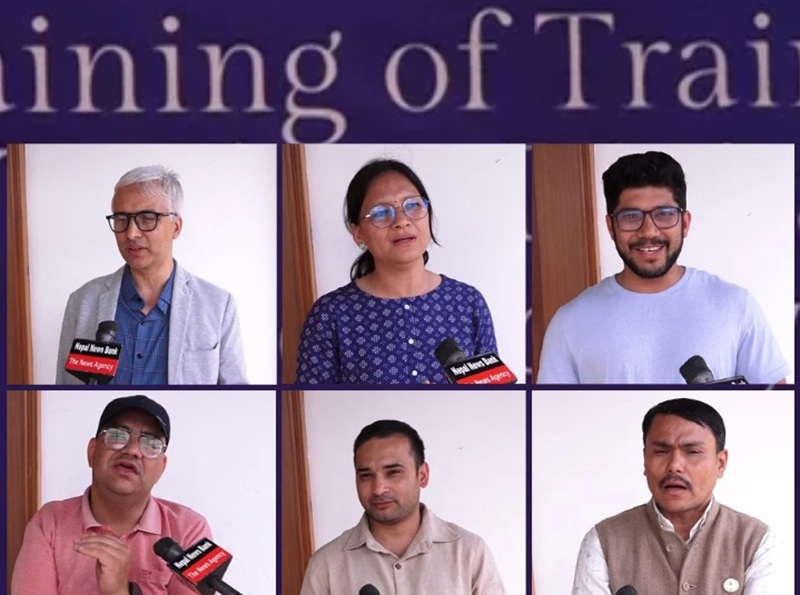
Websites Accessibility in Nepal: Training Civil Servants For Inclusive Digital Services

15th June 2026, Kathmandu
In a significant move toward guaranteeing every citizen’s fundamental right to information, a major initiative has been launched to make Nepal’s government digital services entirely disability-friendly.
Websites Accessibility in Nepal
Recognizing that inaccessible public portals routinely block visually impaired, hearing-impaired, and physically challenged citizens from accessing critical public data, Internet Society Nepal, in collaboration with the Department of Information Technology (DoIT), successfully concluded an intensive two-day “Digital Accessibility Training for Trainers.”
Held on June 12 and 13 (Jestha 29 and 30), the capacity-building program saw the active participation of 18 high-level government officials, including IT officers, engineers, and under-secretary-level personnel from various state agencies.

Addressing Structural and Operational Blind Spots
According to Ananda Gautam, from Internet Society Nepal, an “Accessibility Audit” conducted nearly a year ago revealed a dismal reality regarding public web layouts. Historically, developers constructed government platforms with only average, non-disabled users in mind, leaving out the distinct navigating requirements of persons with disabilities (PWDs).
The audit highlighted deep-seated operational negligence in content publishing. The persistent lack of subtitles in official video broadcasts, missing audio transcriptions, and the widespread use of unreadable document formats (such as non-OCR PDFs) have systematically marginalized specific demographics from state communications.
Chudamani Dhungana, Director at the Department of Information Technology, acknowledged these technical shortcomings.
“Even when we occasionally upgrade a website’s core design, the lack of sensitivity regarding the daily content being uploaded makes those sites completely meaningless for a person with a disability.”
Leveraging GIWMS for Mass Digital Transformation
The Nepalese government currently synchronizes its vast web infrastructure across the country through the Government Integrated Website Management System (GIWMS). However, tech experts emphasize that this system can only prove effective if the administrative hands operating it understand the core principles of digital inclusion.
By targeting central government engineers and IT administrators, DoIT and Internet Society Nepal intend to fix the system at the foundational level.
“We are currently in the implementation phase,” Director Dhungana stated. “Utilizing the lessons from this cohort and backed by external accessibility experts, we are building a robust, mandatory standard that will be strictly enforced across all state platforms.”
Advertisement

Sagar Prasai, Founder of Diverse Pattern Consulting Agency, added that past platforms had suffered from systemic neglect. “Our roadmap going forward is very clear, we are strictly aligning our digital ecosystem with the international benchmarks of WCAG (Web Content Accessibility Guidelines).”
| Core Web Accessibility Gaps Identified | Strategic Tech Solutions Being Deployed |
| Videos lacking synchronized subtitles | Mandatory closed-captioning for public audio-visuals |
| Non-scannable, non-OCR document attachments | Conversion to universally readable, screen-reader-friendly text formats |
| Lack of keyboard-only site navigation paths | Integration of standardized WCAG-compliant design frameworks |
| Segmented, independent portal development | Centralized updates deployed simultaneously via the GIWMS template |
Legal Mandates vs. Ground Reality
While Article 27 of the Constitution of Nepal explicitly guarantees the Right to Information as a fundamental right, complemented by the Rights of Persons with Disabilities Act, the enforcement on the digital front has remained weak.
Padam Pariyar, a member of the National Assembly and leader of the Nepali Congress, stressed that lawmakers must view this issue with gravity.
“We have the legal frameworks on paper, but a disability-friendly website means much more than simply enlarging font sizes or adding basic text-to-speech toggles. It requires multi-dimensional, adaptive features,” MP Pariyar noted. He urged the government to proactively introduce comprehensive digital inclusion bills in parliament, pledging full legislative support to pass and refine such inclusive policies.
Building an Internal Culture of Inclusion
By cultivating specialized skills internally, the state can phase out its heavy reliance on third-party vendors for routine maintenance. Ananda Gautam reiterated that since the centralized GIWMS utilizes a shared base template, adjusting this single architecture could instantly optimize over 800 government websites across Nepal to be disability-friendly.
“This is not a minor adjustment; it is a monumental leap that will empower thousands of citizens with disabilities,” Gautam concluded.
Kapila Shrestha Thaiba, Computer Engineer at the Department of Information Technology, clarified that this initial seminar is just the beginning.
The 18 newly trained officers will now act as Master Trainers within their respective ministries, transferring their technical know-how to their peers.
This strategy ensures that automated testing tools, manual intervention audits, and inclusive protocols are applied from the very inception phase of all future state applications.
For more: Websites Accessibility in Nepal