Digital Financial Security Awareness Guide Nepal

3rd March 2026, Kathmandu
The rapid evolution of the financial landscape in the Federal Democratic Republic of Nepal has transitioned from traditional branch based banking to a dynamic digital ecosystem. As of March 3, 2026 (2082/11/19), the adoption of mobile wallets, QR code payments, and internet banking has reached record levels across both urban and rural provinces. However, this digital leap has necessitated a corresponding rise in Digital Financial Security Awareness. The Nepal Rastra Bank has frequently pointed out that while technology provides the infrastructure for seamless transactions, the weakest link in the security chain remains the human element. Fraudsters increasingly employ social engineering, phishing, and identity theft to exploit uninformed users. In the year 2082, understanding the multi layered defense mechanisms of digital finance is no longer a technical luxury but a fundamental requirement for every citizen holding a bank account or a digital wallet.
Digital Financial Security Awareness
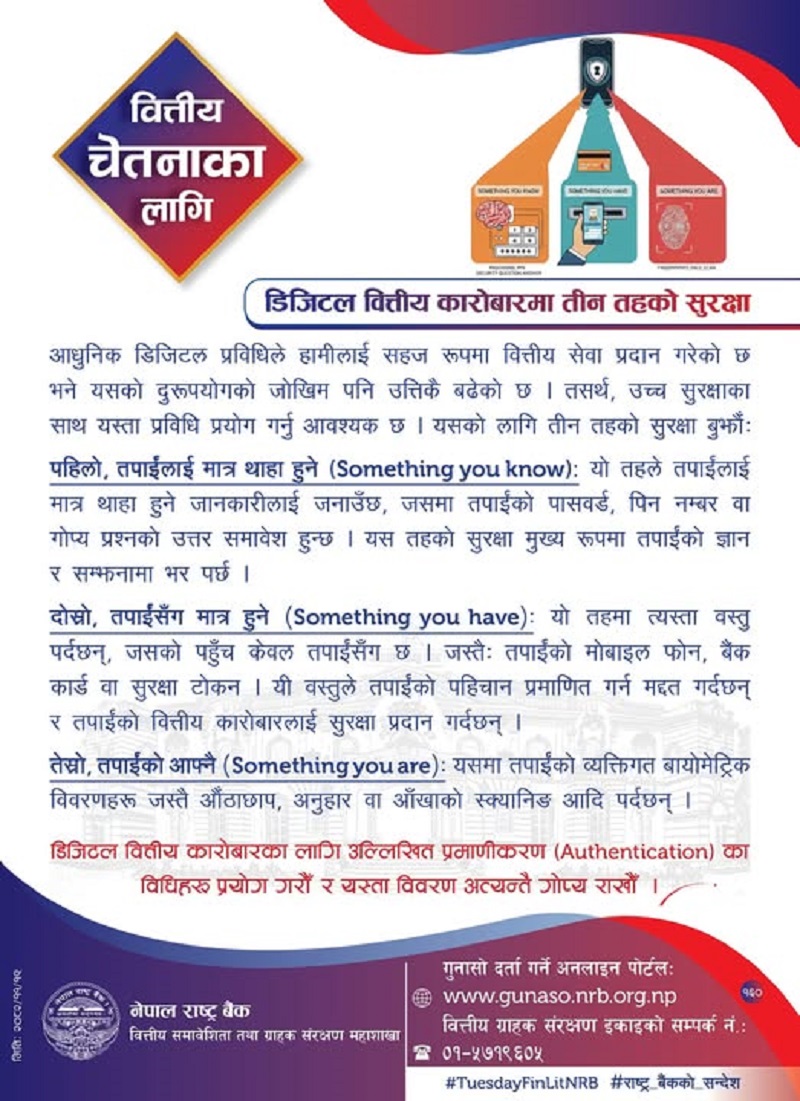
Digital financial security is built upon the principle of multi factor authentication, which organizes security measures into three distinct layers. This framework ensures that even if one layer of defense is breached, the others act as a fail safe to prevent unauthorized access to funds. The first layer is known as something you know. This refers to knowledge based authentication, which includes traditional passwords, Personal Identification Numbers (PINs), and the answers to secret security questions. These are the most common targets for cybercriminals. Digital Financial Security Awareness starts with the absolute rule that these credentials must remain confidential. In Nepal, many fraud cases involve individuals sharing their ATM PIN or mobile banking password with someone claiming to be a bank official or a lucky draw representative. Users must remember that no legitimate financial institution will ever ask for a password or PIN over a phone call or text message.
The second layer of security is defined as something you have. This is possession based authentication and is a critical component of modern banking security in 2082. This layer typically involves a physical device or a unique code that is sent to a device in the user’s possession. The most common example is the One Time Password (OTP) sent via SMS to a registered mobile number. Other examples include hardware tokens, debit cards, or specific security keys. Even if a hacker manages to steal a user’s password, they cannot complete a transaction without the OTP or the physical device. This is why scammers often try to trick users into forwarding their OTP or installing remote access apps that allow them to read incoming messages. Maintaining control over your registered SIM card and never sharing an OTP is a cornerstone of digital safety.
The third and most advanced layer of security is something you are. This involves biometric authentication, utilizing unique biological characteristics to verify identity. In the year 2082, most smartphones and banking applications in Nepal support fingerprint scanning, facial recognition, and even iris or voice recognition. Biometric data is incredibly difficult to replicate or steal, providing the highest level of security available to the average consumer. Digital Financial Security Awareness programs strongly encourage users to enable biometric login features on their banking apps. This adds a physical barrier that prevents unauthorized use of the app even if the phone itself is stolen or lost. By combining these three factors, knowledge, possession, and biometrics, the probability of a successful fraudulent transaction is reduced to nearly zero.
The strategic importance of multi factor authentication lies in its ability to protect the growing digital economy of Nepal. The rise of Fonepay, Khalti, eSewa, and various mobile banking platforms has significantly improved financial inclusion, allowing people in remote areas to pay bills and transfer money without traveling to a city. However, this also means that the national wealth is increasingly stored in digital formats. The Nepal Rastra Bank has implemented strict guidelines requiring all licensed financial institutions to enforce at least two factors of authentication for any significant transaction. This regulatory focus is designed to build public trust in digital systems. When users feel secure, they are more likely to participate in the formal economy, which leads to greater transparency and reduced cash handling costs for the state.
Advertisement

Despite these technical safeguards, the primary threat in 2082 remains social engineering. This is the psychological manipulation of people into performing actions or divesting confidential information. Phishing, where users are sent fake links that look like their bank’s login page, is a common tactic. Vishing, or voice phishing, involves fraudulent phone calls that create a sense of urgency, such as claiming an account has been compromised and requiring immediate verification. Digital Financial Security Awareness involves teaching users to be skeptical of any unsolicited communication. One should always verify the official website URL, check for the lock icon in the browser address bar, and use the official apps downloaded from verified stores like Google Play or the Apple App Store rather than clicking on links sent through email or social media.
The responsibility for digital financial security is shared between the regulator, the financial institutions, and the individual users. While banks are investing heavily in firewalls, encryption, and fraud detection algorithms that use artificial intelligence to spot unusual spending patterns, the user must practice good cyber hygiene. This includes regularly updating the operating system of their mobile devices, using different passwords for different services, and enabling transaction alerts. In the year 2082, most Nepali banks offer real time SMS and email notifications for every transaction. Monitoring these alerts allows a user to spot unauthorized activity immediately and report it to the bank’s 24/7 fraud hotline. Early reporting is often the difference between recovering stolen funds and losing them forever.
As Nepal moves toward a cashless society, the role of security awareness will only grow. The introduction of the National Payment Switch and the increasing interoperability between different wallets and banks mean that a single security breach could potentially have a ripple effect across multiple platforms. Therefore, the government has integrated digital literacy into various public service initiatives. By educating the workforce, especially those in the SME and agricultural sectors, the country is building a more resilient financial foundation. Digital Financial Security Awareness is not just about protecting money; it is about protecting the digital identity and the future of every Nepali citizen in the global information age.
In conclusion, the Digital Financial Security Awareness Guide for Nepal highlights that while technology provides the tools for convenience, education provides the armor for safety. By understanding and utilizing the three layers of authentication, something you know, something you have, and something you are, users can effectively shield themselves from the majority of cyber threats. In the year 2082, as we embrace the benefits of a digitized economy, let us remain vigilant and disciplined in our digital habits. The confidentiality of your PIN, the security of your device, and the uniqueness of your biometrics are your best allies in ensuring that your financial journey remains safe, reliable, and prosperous.
For More: Digital Financial Security Awareness