
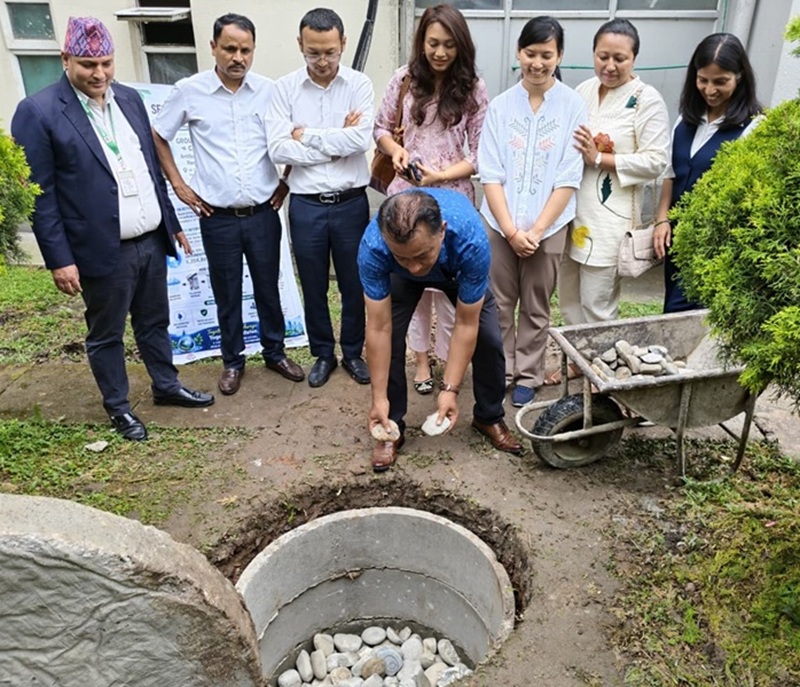
Artificial Groundwater Recharge Project Launched in Civil Service Hospital Kathmandu

2nd July 2026, Kathmandu
Artificial Groundwater Recharge Project Launched at Civil Service Hospital to Strengthen Kathmandu’s Urban Water Security
A joint initiative by the Centre for Integrated Urban Development (CIUD) and Bottlers Nepal Limited in the Civil Service Hospital to promote sustainable urban water management and climate resilience.
Artificial Groundwater Recharge Project
A groundbreaking ceremony was held today to mark the launch of the Artificial Groundwater Recharge Project at Civil Service Hospital, a joint initiative by Bottlers Nepal Limited (BNL) and the Centre for Integrated Urban Development (CIUD).
The ceremony was attended by representatives from Civil Service Hospital, Coca-Cola Beverages Nepal (CCBN), and the Centre for Integrated Urban Development, reaffirming the importance of collaborative action in addressing Kathmandu’s growing urban water challenges.
As Kathmandu continues to experience declining groundwater levels and increasing urban flooding, the project will demonstrate a practical groundwater recharge solution that captures rainwater and stormwater runoff to replenish underground aquifers.
Covering a catchment area of approximately 4,345 square meters, the system is expected to replenish nearly 6.25 million liters of groundwater annually, while reducing localized flooding and contributing to more resilient urban water management.
Achyut Raj Regmi, Under Secretary of Civil Service Hospital, shared, “We are happy to have Coca-Cola and CIUD’s initiation of replenishing groundwater in our hospital area, as this gives direct benefits to the communities around the hospital. We look forward to more such assistance, through their socially responsible programs that benefit society in the future”.
BNL (and CCBN) and CIUD demonstrate. Yet, another long-standing partnership in water stewardship programs following the successful implementation of groundwater recharge initiatives at Ranibari (Ward 3, Kathmandu Metropolitan City), UCEP in Thimi Municipality, Rajdal Army Barrack in Lalitpur Metropolitan City, Balaju Park (Ward 16, Kathmandu Metropolitan City), and most recently in Wards 22 and 25 of Kathmandu Metropolitan City. Together, these initiatives demonstrate how public-private partnerships can deliver scalable, community-focused solutions to Nepal’s growing water challenges.
Advertisement

The Artificial Groundwater Recharge Project is expected to serve as a replicable model for hospitals, schools, government offices, and other public institutions throughout Kathmandu Valley, contributing to long-term groundwater conservation, improved urban resilience, and sustainable water management.

About Coca-Cola Beverages in Nepal
Coca-Cola Beverages Nepal refreshes consumers across the country through its core product offerings of Coca-Cola, Sprite, Fanta, and Kinley, and impacts thousands as a System.
The company works with WaterAid Nepal, Centre for Integrated Urban Development (CIUD), Smart Paani, and Splash on innovative integrated water management solutions for water conservation, water replenishment, and to improve the livelihoods of communities, which has made Coca-Cola a water-positive company.
As part of The Coca-Cola Company’s global commitment to better Waste Management, Coca-Cola Beverages Nepal has been working with partners such as Doko Recyclers and Khaalisisi to support the global mission to collect and recycle every bottle we sell by 2030.
Through the Saksham program, Coca-Cola Beverages Nepal and Coca-Cola Nepal are empowering over 3000 women retailers by providing training on financial literacy, hospitality, sanitation management, and the use of digital wallets. Coca-Cola Beverages Nepal continually engages in locally relevant initiatives to bring about a positive difference to the lives of communities across the country.
About CIUD
The Centre for Integrated Urban Development (CIUD) is a non-governmental organization dedicated to promoting people-centered, sustainable urban development across Nepal.
CIUD collaborates with municipalities, communities, and development partners to implement innovative solutions in urban planning, climate resilience, water security, sanitation, and environmental management, complementing government efforts to build more livable and resilient cities.
For more: Artificial Groundwater Recharge Project


