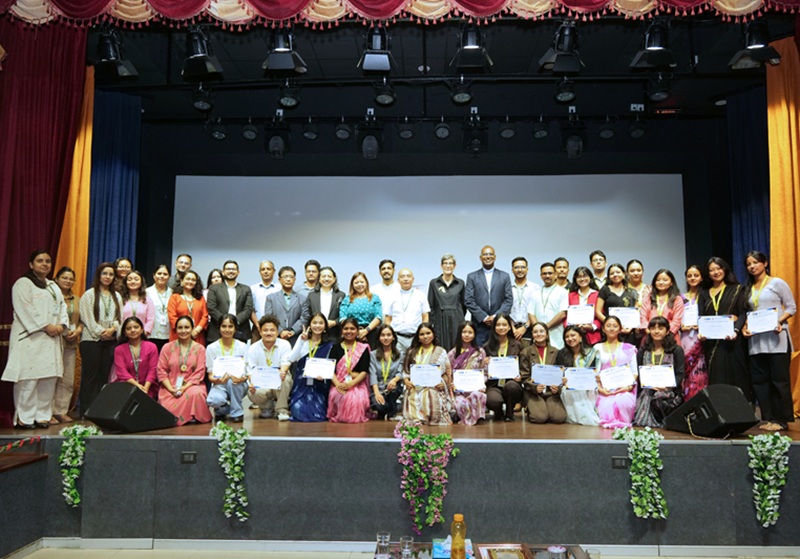
AI Can Amplify Both Facts and Fake News: Swiss Ambassador Urges Nepalese Youth to Fight Misinformation

1st July 2026, Kathmandu
In an era dominated by instant information and artificial intelligence, the line between truth and fabrications is becoming increasingly blurred.
AI Can Amplify Fake News
Addressing this critical challenge, Her Excellency Dr. Danielle Meuwly, Swiss Ambassador to Nepal, has called on the younger generation to champion critical thinking and rigorous fact-checking.
Speaking as the special guest at the 41st edition of the MediaTalk series at St. Xavier’s College, Ambassador Meuwly highlighted the dual nature of emerging technologies.
“We live in a time where information is abundant—instant and powerful. Whether as journalists, content creators, or social media users, we all shape public narratives. AI can amplify both facts and fake news, making fact-checking essential, especially for young people,” Dr. Meuwly stated.
With the rapid integration of AI tools in media production and consumption, the Ambassador reminded the audience of their civic responsibility: “Your voice matters. Your choices matter. And your commitment to critical thinking, integrity, and informed engagement will shape the future of democracy.”

Journalists vs. Content Creators: Competing or Complementing?
The panel discussion, themed “Journalists vs. Content Creators: Complementing or Competing in Shaping Public Narratives,” brought together leading voices from Nepalese mainstream media and digital landscapes to dissect how news is evolving.
1. The Shift to Short-Form Media
Umesh Chauhan, Group Editor at Himalaya TV and Onlinekhabar.com, shed light on shifting audience behaviors. He observed that today’s youth are increasingly consuming short-form content over detailed, traditional reporter reportages.
Advertisement

To bridge this gap, Chauhan invited mass communication students to step into real newsrooms. He emphasized that firsthand newsroom experience is vital for understanding the foundational role journalists play in fostering a democratic society.
2. Content Creators as Democratic Watchdogs
Offering a perspective from the digital creator space, content creator and cultural critic Suraj Subedi argued against the notion that creators lack journalistic rigor. Subedi asserted that content creators can actively serve as watchdogs. By critically examining and challenging their own biases, creators can produce balanced, responsible, and highly impactful content that complements traditional media.
3. The Central Question in the Age of AI
Summarizing the core dilemma of modern media, Chun Bahadur Gurung, Faculty Coordinator of the MediaTalk series, noted that the debate shouldn’t center on who shapes the narrative, but how they do it.
“The central question in the age of AI is not whether journalists or content creators shape public narratives, but how both can responsibly complement each other in strengthening democratic societies,” Gurung stated, reinforcing that journalism remains a pillar of democracy when practiced in accordance with its core principles.
Academic Excellence and Media Literacy
The event concluded with high praise from Fr. Dr. Augustine Thomas, S.J., Principal of St. Xavier’s College. He commended the intellectual depth of the session, noting that the discussion truly stimulated the minds of the audience.
“From the thoughtful selection of the theme to its excellent execution, the talk series was a visible example of how well-formed the Xavierians are, and of the competence and dedication of the faculty who mentor them,” said Fr. Thomas.
As AI continues to rewrite the rules of communication, the consensus from the 41st MediaTalk remains clear: whether writing a deeply researched investigative report or producing a 60-second viral video, truth, integrity, and critical thinking must remain non-negotiable for the Nepalese media ecosystem.
For more: AI Can Amplify Fake News