Digital Gandaki Sambad Conducted Successfully: Multi-Stakeholder Ecosystems with Actionable Policy Roadmap from the CAN Federation

7th June 2026, Kathmandu
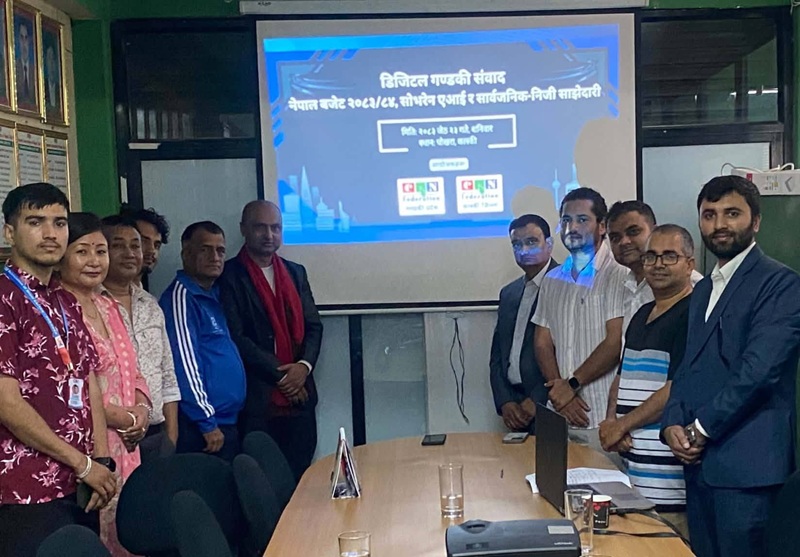
The tech landscape of Nepal marked a historic milestone as Digital Gandaki Conducted Successfully its highly anticipated regional conclave in Pokhara, Kaski.
Digital Gandaki Sambad Conducted

Jointly organized by CAN Federation Gandaki Province in association with the CAN Federation Kaski Chapter, the event served as a powerful catalyst for driving the nation’s technology agenda forward.
Delivering a powerful keynote address, IT industry leader and Acting President of the CAN Federation, Chiranjibi Adhikari, unveiled a groundbreaking conceptual framework: “Digital Gandaki Sambad 2026: Driving Nepal’s National IT Agenda Through Sovereign AI & Strategic Policy Advocacy.” This vision establishes a definitive path toward regional self-reliance, secure infrastructure, and data sovereignty.
CAN Federation Gandaki Province President Gunanidhi Pandey praised the visionary conceptual framework developed and initiated by Digital Transformation Leader Chiranjibi Adhikari, emphasizing that this blueprint for Sovereign AI and strategic policy advocacy serves as a critical baseline for driving the region’s and the nation’s digital agenda forward.”
The event drew widespread acclaim from local leadership. Purushottam Kunwar (President, CAN Federation Kaski) noted that Adhikari’s leadership and vision provide an actionable roadmap that bridges high-level policy with municipal execution, reaffirming CAN Kaski’s absolute commitment to making these goals a reality. Meanwhile, Sabi Sherchan (President, ICT Cooperative Pokhara) praised the keynote presentations for providing highly insightful breakthroughs on regional internet structures, digital payments expansion, and the practical deployment of secure digital governance.

Activating Multi-Stakeholder Ecosystems for Regional Tech Growth
A central takeaway from the conclave is that sustainable digital transformation cannot happen in isolation. As Digital Gandaki conducted its sessions successfully, the framework highlighted how a robust tech ecosystem requires deep synchronization among three critical pillars: the Private Sector, Academia, and Government Units.
The Private Sector: Co-Investment & Digital Incubators
To build a resilient digital economy, the framework details strategic opportunities for the private sector:
Infrastructure Co-Investment: Mobilizing private capital to expand localized digital infrastructure and scale secure financial transaction networks across remote trekking circuits.
Regional Tech Hubs & Incubators: Deploying specialized municipal spaces designed to foster home-grown IT firms and fintech startups, keeping innovation local.
Academia & Research: Restructuring for the AI Era
To stop the regional brain drain and equip youth with highly relevant industrial skills, the roadmap outlines immediate updates to IT education:
Curricula Restructuring: Re-aligning university IT education with native AI development standards and global IT service export needs.
Localized Apprenticeships: Supplying a direct workforce pipeline that is explicitly trained and prepared for the unique technical demands of the Nepalese tech landscape.
Actionable Policy Roadmap from the CAN Federation
Turning high-level objectives into measurable, real-world results requires strong policy backing. The Actionable Policy Roadmap from the CAN Federation introduces aggressive reforms designed to create a self-reliant technological ecosystem:
Policy and Tax Reforms: Actively advocating for a 1% corporate tax rate for domestic IT firms to stimulate economic growth and make Nepal a competitive hub for tech offshoring.
Advertisement

Procurement Optimization: Modernizing the Public Procurement Act to actively support regional software firms by establishing a clear “Nepal Made Software” procurement preference in public contracts.
Sovereign AI & Localized Governance: Deploying localized Large Language Models (LLMs) within municipal administrative offices to securely and efficiently automate public tasks under strict domestic oversight.
National Security Baselines: Mandating strict compliance with the National Minimum Security Standard (NMSS) alongside standardized cybersecurity audits for all municipal portals and the Nagarik App integration to protect public privacy.
Green Infrastructure: Capitalizing on Gandaki’s massive hydroelectric energy potential to build sustainable, green data centers and ICT Innovation Labs in Pokhara.
Contextual Blueprint: Navigating the Provincial and Local Reality
While the vision of Digital Gandaki Conducted Successfully establishes an optimistic blueprint, the framework matches these goals with data from the official file, “Digital Governance in Palika and provinces Efforts and Practices.pptx”. This analysis highlights where the province stands today and the hurdles it must overcome:
Baseline Progress in Gandaki Province
According to provincial assessments, Gandaki is making commendable progress. The province currently utilizes an Online Project Monitoring System, an automated Personnel Information System (PIS), and is preparing to deploy an official E-Cabinet framework. These efforts are directly guided by its established E-Governance Masterplan and Digital Gandaki Concept.
Systemic Challenges Facing Provincial Governance
Across the broader national landscape, certain weaknesses require targeted policy interventions:
Workforce Instability: Human resource capacity remains highly unstable across most Provincial Governments (PGs). The technical workforce consists mostly of temporary staff or entry-level roles, with a severe deficit of permanent, senior IT policymakers (such as Under Secretaries or Joint Secretaries) available for policy support.
Institutional and Infrastructure Gaps: Outside of Lumbini, provinces generally lack a formal, structural Information and Communication Technology Academy. Furthermore, while the adoption of Government Cloud hosting is growing, the actual implementation of regional backup data centers has not yet been realized.
Local Government (LG) Digital Gaps & Hurdles
An analysis of over 434 local governments outlines a stark digital divide that the CAN Federation roadmap aims to close:
The Infrastructure Divide: Approximately 6% of local ward offices completely lack a regular, stable connection to electricity, and 5% operate with no internet connection at all.
Software Proliferation (“Mushrooming Systems”): Local units frequently suffer from duplicated, isolated software systems built by individual vendors for identical thematic processes. This results in data silos, vendor lock-in, poor or missing Service Level Agreements (SLAs), and a lack of interoperability.
Operational Imbalance: Most local governments actively deploy software modules for basic budgeting, accounting, and municipal revenues, but more advanced spatial planning tools and master data management platforms remain heavily under-utilized.
Shaping a United Digital Future
The success of the Digital Gandaki Sambad 2026 demonstrates that a transition to the AI era is entirely within reach when guided by clear ground actions. By focusing on Data for Decision Making (D4D), updating outdated legal frameworks, and eliminating data silos, Nepal can maximize its global competitiveness.
Ultimately, the blueprint relies on the three constitutional pillars: Cooperation, Coordination, and Coexistence. By aligning federal leadership, provincial policy support, and local municipal execution, the Actionable Policy Roadmap from the CAN Federation provides the perfect path to turn these high-level objectives into a thriving digital reality.
For more: Digital Gandaki Sambad Conducted