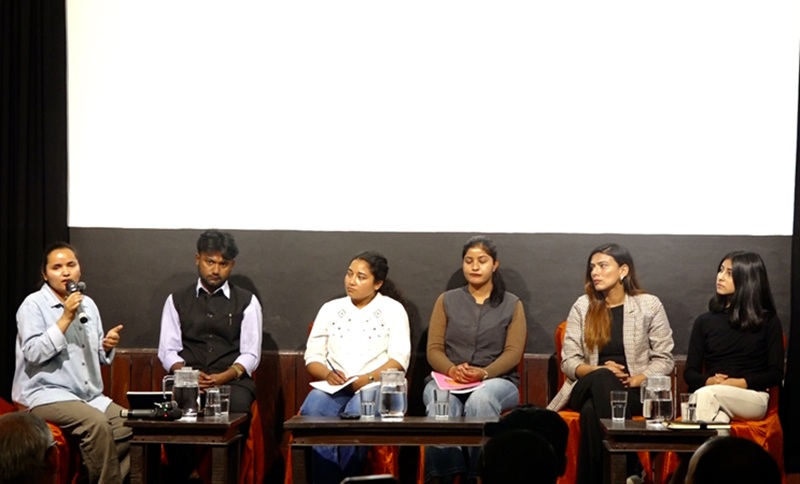
GenZ Activist Amisha Parajuli Explains Why Community Action Comes Before State Laws in Cyber Safety

17th May 2026, Kathmandu
Speakers at a recent panel discussion on the rise of online harassment and the responsibilities of the state and community have warned that social awareness and collective accountability are rapidly declining in Nepal’s digital ecosystem.
GenZ Activist Amisha Parajuli
The event highlighted how the lack of immediate support from immediate social circles leaves victims of online violence highly vulnerable and isolated.

The Failure of Social Responsibility in the Digital Age
Speaking at the event, GenZ activist Amisha Parajuli argued that relying solely on state intervention or legal frameworks is not enough to combat the daily harassment Nepalese women face online. She emphasized that a strong social defense system must be established before looking toward the government.
“Women face various forms of violence every single day. The tragedy is that the people around us fail to fulfill their basic human duty. If social responsibility took precedence over state responsibility, this level of violence wouldn’t exist.” Amisha Parajuli, GenZ Activist
Parajuli criticized the passive bystander culture deeply rooted in today’s society. She pointed out the hypocrisy where neighbors and community members are quick to judge or police women’s behavior but choose to stay silent when those same women are targeted or cyberbullied.
“The community that watches everything from next door must also step up, unite, and stand as a shield to protect victims when violence occurs,” Parajuli added, calling for an immediate end to the culture of silence.
Individual-Centric Attacks vs. Constructive Dialogue
Adding a broader perspective to the decline of digital civic consciousness, fellow GenZ activist Majid Ansari remarked that society has continuously enabled a culture rooted in aggression.
He noted that public discourse has shifted away from constructive, thought-centric debates toward highly personalized, violent attacks.
Advertisement

“Whether looking at our past or present, we have consistently incentivized violence-driven change,” Ansari observed. “We have shifted from attacking ideas to attacking individuals.
When the entire political narrative or discussions around dissolving parliament can be triggered by a single social media status, we really need to look inward and evaluate the current state of our collective intellect.”
Ansari pointed out that the toxic comments, trolling, and reactionary behavior seen across Nepalese social media platforms are a direct reflection of society’s dropping awareness levels. He urged for a deep psychological re-evaluation of how digital tools are being utilized by the youth and the public at large.
Moving From Bystander to Protector
The consensus among the youth leaders was clear: legislative laws and cyber bureaus can only do so much post-incident. To create a genuinely safe digital space for Nepalese women, a cultural shift is mandatory.
End the Silence: Community members must actively call out digital harassment when they see it happening within their networks.
Prioritize Collective Action: Society needs to transition from blaming the victim to holding perpetrators accountable.
Foster Intellectual Discourse: Social media users, especially GenZ, need to pivot away from personal defamation and move toward healthy, issue-based discussions.
As digital spaces continue to expand in Nepal, the call to action from these Gen Z voices serves as a timely reminder that cyber safety begins not with a court order, but with the collective conscience of the community.
For more: GenZ Activist Amisha Parajuli