Indra Jatra World’s Oldest Living Festivals: Culture Expert Dr. Madhav Bhattarai

25th September 2026, Kathmandu
Explore the deep historical and cultural roots of Indra Jatra with culture expert Dr. Madhav Bhattarai. Discover how this ancient Nepalese festival blends Vedic, Buddhist, and Tantric traditions, the veneration of the Living Goddess Kumari, and centuries-old rituals that showcase Nepal’s rich heritage to the world.
Across the Kathmandu Valley and various regions of Nepal, the traditional festival of Indra Jatra is being celebrated with rituals dedicated to Lord Indra, the deity of rain and good harvest. Celebrated annually starting on Bhadra Shukla Dwadashi with the ceremonial hoisting of the Indradhwaja (flagpole) at Hanumandhoka, the festival reaches its primary observance on Bhadra Shukla Chaturdashi.
Culture expert Dr. Madhav Bhattarai emphasizes that Indra Jatra is not merely a regional event, but one of the most ancient living cultural traditions in the world.
Key Highlights from Dr. Madhav Bhattarai
Ancient Historical Roots:
Dr. Bhattarai notes that references to Indra-related traditions are documented in ancient classical texts, including Bharat Muni’s Natyashastra, dating back to around the 3rd century BCE. While many Western cultural celebrations span 100 to 150 years, Nepal continues to observe living traditions that date back thousands of years.
Symbolism of the Indradhwaja (Lingo):
The ritual of hoisting the flag pole at Hanumandhoka carries deep religious and state significance. According to classical scriptures, erecting the pole symbolizes the attainment of sovereign power and victory over adversaries.
Multi-Community Participation:
Indra Jatra has evolved into a shared heritage across the Kathmandu Valley. People from diverse ethnic, cultural, and social backgrounds actively participate, making it a unified civic celebration rather than an event limited to a single community.
Advertisement

Synthesis of Vedic, Buddhist, and Tantric Faiths:
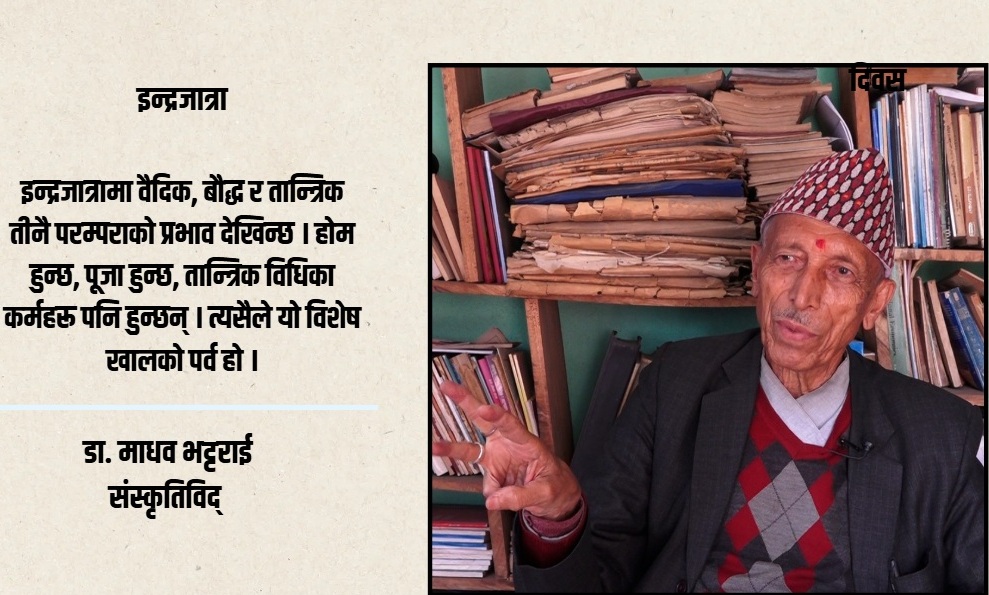
The festival reflects a unique convergence of Nepal’s primary religious traditions. It integrates Vedic prayers, Buddhist practices, and Tantric rites—including fire rituals (homa), worship (puja), and esoteric ceremonies.
The Kumari (Living Goddess) Tradition:
The chariot procession of Goddess Kumari highlights a distinct aspect of Nepali culture: venerating a living human being as a divine deity. Similar Kumari traditions are preserved across Kathmandu, Patan, Bhaktapur, and Nuwakot.
Agricultural & Spiritual Significance:
As an agrarian nation, worshiping Indra—the king of gods and commander of rain—is directly tied to ensuring seasonal rainfall and agricultural prosperity (sahakal). Pulling the chariot during the procession is spiritually believed to cleanse past sins and avert misfortune.
Global Cultural Promotion:
Dr. Bhattarai urges the state to leverage Indra Jatra as a platform to showcase Nepal’s cultural identity globally. With foreign diplomats and international dignitaries attending the celebrations, structured programs should be organized to highlight the festival’s historical depth to the world.”Our ancestors have kept these traditions alive for thousands of years. The chariot processions and public town parades foster collective unity and deep respect for our heritage. It is the duty of the new generation to preserve and carry forward this rich legacy.”
— Dr. Madhav Bhattarai