Data Hub Ransomware Attack: NEPSE Trading Halted, Backup Status & Security Lessons

22nd September 2026, Kathmandu
Explore how the Data Hub ransomware incident exposes critical vulnerabilities in Nepal’s digital infrastructure. Get expert recommendations on regular security assessments, investing in cybersecurity human resources, and robust disaster recovery protocols.
Data Hub Ransomware Attack
Ransomware Attack on Data Hub and Nepal’s Stock Market: Lessons, Security Challenges, and Paths to Reform
An incident in the recent history of the Nepalese capital market has raised serious questions about the security of the country’s digital infrastructure.
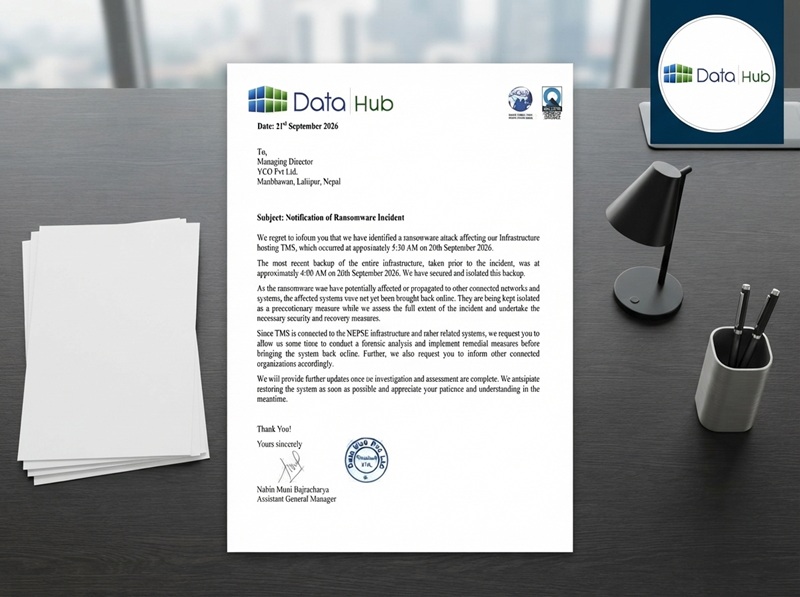
A ransomware cyberattack has hit Data Hub Pvt. Ltd., the primary data center hosting servers for 72 brokerage houses registered under the Nepal Stock Exchange (NEPSE). Data Hub formally notified Yco (managing the TMS) regarding the breach, prompting immediate action.
Following the attack, the system was completely isolated and taken offline to mitigate further potential risks. NEPSE reported technical issues originating at Data Hub since the morning of September 20, leading to the suspension of regular trading sessions under Rule 21(1) of the Securities Listing and Trading Regulations, 2075.

Background and Current Status of the Incident
Data Hub confirmed that the ransomware attack occurred at approximately 5:30 AM on September 20.
Timing of Attack: September 20, around 5:30 AM.
Backup Status: According to Data Hub, all data up to 4:00 AM on September 20 (about an hour and a half before the attack) remains secure. The company claims that this recent backup was isolated from the main network to protect core data.
Market Impact: Regular trading was halted after the Stock Brokers Association of Nepal requested a market suspension to prevent potential cascading damage to NEPSE’s core trading infrastructure.
Understanding the Reality of “Data Hub Ransomware Affected”
Ransomware attacks have become a primary menace for corporate houses and financial institutions worldwide. When malicious actors infiltrate a system, they encrypt critical data and demand a ransom for its release.
Viewing this incident through the lens of Data Hub Ransomware Affected highlights that this is not merely a software glitch, but a severe breach of institutional defense mechanisms.
This incident strongly indicates that financial and data infrastructure in Nepal is increasingly becoming a target for sophisticated cybercriminals.
The Threat of Nepal’s First Data Center APT Attack
In cybersecurity terminology, an Advanced Persistent Threat (APT) is exceptionally dangerous. It involves prolonged, unauthorized access where threat actors lurk undetected within a network before executing high-impact damage.
Exploiting Vulnerabilities: Traditional firewalls and basic antivirus software are no longer sufficient to stop advanced APT tactics.
Advertisement

Financial Sector Risks: Many financial institutions and data centers in Nepal still rely on outdated security postures, leaving them susceptible to high-level intrusions.
Critical Recommendations for the Future
To prevent future crises, financial and technical institutions in Nepal must immediately adopt the following strategies:
1. Regular Security Assessments
Vulnerability Scanning: Frequently audit servers, networks, and applications to identify weak points.
Penetration Testing: Employ ethical hackers to simulate real-world attacks against your own infrastructure before malicious actors do.
2. Invest in Human Resources (HR), Not Only Machines and Applications
Employee Security Awareness: Most ransomware attacks initiate via phishing emails clicked by unsuspecting staff. Continuous cybersecurity training is mandatory.
Specialized Talent: Purchasing expensive hardware and software alone does not guarantee security. Dedicated cybersecurity experts are required to monitor and manage these systems actively.
3. Disaster Recovery (DR) Can Also Fail
Many organizations assume a standard backup is enough. However, if backup servers are continuously synced and online, ransomware can corrupt them simultaneously.
3-2-1 Backup Rule: Maintain 3 copies of data, across 2 different media types, with at least 1 copy kept completely offline (air-gapped) to ensure business continuity even if primary disaster recovery measures fail.
Conclusion
The ransomware attack on Data Hub serves as a stark warning to Nepal’s entire digital economy. Without prompt forensic investigations, swift attribution, and permanent remediation of security vulnerabilities, similar incidents could trigger even wider financial instability.
To restore and maintain investor and broker trust, a cultural and structural shift toward comprehensive cybersecurity beyond just technology investments has become non-negotiable.
How confident are you that your organization’s current data backup and security policies can withstand modern ransomware threats?
For more: Data Hub Ransomware Attack