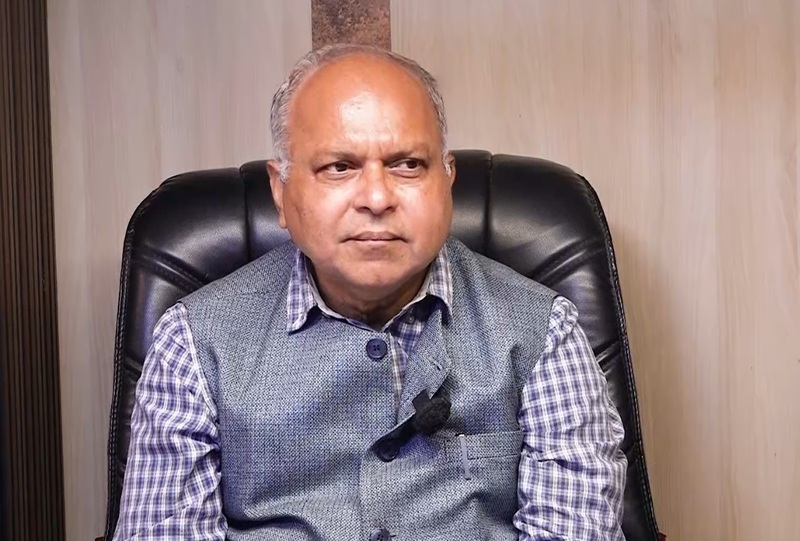
State Must Not View Healthcare Investments Solely Through the Lens of Revenue and Expenditure: Dr. Anjani Kumar Jha

25th September 2026, Kathmandu
Dr. Anjani Kumar Jha, President of the Kathmandu Cancer Center, emphasizes that government investment in the health sector should be viewed as long-term national development rather than immediate expenditure. He warns that a lack of funding drives healthcare brain drain and calls for a stronger referral system to manage hospital overcrowding.
The debate over public funding for healthcare in developing nations often centers on short-term budgets, immediate revenues, and annual expenses. However, according to Dr. Anjani Kumar Jha, President of the Kathmandu Cancer Center and former Vice-Chairman of the Medical Education Commission, viewing healthcare through a narrow economic lens is a critical policy mistake.
In a recent comprehensive interview with Nepal News Bank, Dr. Jha highlighted that state investments in public health should not be evaluated by immediate profit margins. Instead, they must be treated as long-term foundational investments in human capital and national productivity.
1. Healthcare Investment vs. National Security Budgets
Drawing a parallel to the defense sector, Dr. Jha questioned why the government readily allocates dedicated annual budgets for security forces—such as the Army, Police, and Armed Forces—without demanding direct financial returns, yet applies hyper-stringent cost-benefit analysis to healthcare.
“Investing in the health sector is not a matter of calculating how much was spent and how much revenue was generated in a year,” Jha explained. “When a healthy workforce is created, productivity and work quality rise, ultimately benefiting society and the entire country.”
Without sustained financial backing, hospitals across Nepal struggle to procure modern medical equipment, expand clinical capacity, and handle escalating patient influxes.

2. The Root Cause of Doctor Brain Drain in Nepal
One of the most pressing concerns in Nepal’s medical landscape is the continuous exodus of qualified doctors, nurses, and healthcare professionals seeking employment abroad. Dr. Jha warns that unless the government prioritizes healthcare infrastructure and improves institutional working environments, the brain drain crisis will only accelerate.
Low investments directly translate to:
-
Outdated hospital technology and insufficient diagnostic tools.
-
Unmanageable workloads and high stress for medical staff.
-
Disputes surrounding fair remuneration, stipends, and career security for resident doctors and interns.
3. Reforming Medical Education and Infrastructure Planning
Reflecting on the expansion of medical education—which began with the Institute of Medicine (IOM)—Dr. Jha noted that his tenure at the Medical Education Commission focused on establishing new government medical institutions to curb the outflow of students traveling abroad for MBBS degrees.
During his term, five government medical colleges were advanced, including:
Advertisement

-
Gothgaun (under Purvanchal University)
-
Madan Bhandari Academy of Health Sciences (Hetauda)
-
Pokhara and Dang institutions
-
Madhes Institute of Health Sciences (Janakpur)
However, Dr. Jha sharply criticized poor bureaucratic planning. Citing Geta Medical College as a primary example, he pointed out the absurdity of investing over 7 billion rupees into physical building construction only to later stall operations under the pretext of lacking a budget for equipment and staffing posts.
“It is unacceptable to claim there is no budget for equipment after a massive building is already completed,” he stated. “Planning for faculty and medical gear must begin the moment construction starts.”
4. Solving Hospital Overcrowding: Beyond Adding More Beds
Major referral hubs like Bir Hospital and the Tribhuvan University Teaching Hospital constantly face overwhelming patient congestion. However, Dr. Jha argues that simply scaling up bed capacity from 2,000 to 10,000 is not a viable solution.
The Problem: Treating everything from minor seasonal infections to complex liver transplants under one roof creates severe administrative gridlock.
The Solution: Strengthening primary healthcare centers, upgrading secondary-level regional hospitals, and enforcing a strict structured referral system so that tertiary centers only manage specialized, high-acuity cases.
5. Protecting Healthcare Workers and Rebuilding Public Trust
Addressing the alarming rise of physical assaults, vandalism, and aggressive protests against doctors following patient deaths, Dr. Jha urged the public to rely on legal channels rather than mob violence.
He also cautioned media outlets against prematurely labeling every unfortunate clinical outcome as “medical negligence” before proper forensic and medical investigations take place. Such sensationalized narratives erode public trust in domestic medical systems and inadvertently push more patients to seek expensive treatments abroad.
Furthermore, while private medical colleges must face stringent oversight from regulatory bodies, Dr. Jha advocates for constructive dialogue rather than hostility, ensuring that standardized tuition fees, exam costs, and practical material expenses remain transparent for students.
Conclusion
As non-communicable diseases like cancer continue to rise due to shifting lifestyles and environmental factors, early detection and localized treatment access are more critical than ever. Dr. Jha’s overarching message remains clear: fostering a healthy generation is the ultimate national investment.
Until the state shifts its perspective from viewing healthcare as a financial burden to recognizing it as a pillar of national security, retention of medical talent will remain an uphill battle.